

As many Saporta Report readers will remember, last May, an extended-stay Economy Motel in Roswell, Georgia, was shut down after serious concerns were raised about uninhabitable living conditions, including mold and pests, drug use, and sex trafficking. Before its closure, this hotel was on the Fulton County Schools bus route, picking up dozens of children who called the hotel home. The motel had 100 occupied rooms, including seniors and families with 50 children in these rooms.
Across Georgia, hundreds of extended-stay motels serve as residences for families and individuals who have few other affordable housing options. An estimated 40,000-50,000 families in the metro area of Georgia consider extended-stay motel rooms their primary residence. A Dekalb study of motel residents conducted by GSU released earlier this year identified 35% of motel occupants are children.
Brian Goldstone’s Pulitzer-prize winning book, There Is No Place for Us: Working and Homeless in America powerfully documents the realities of the working homeless, like those trapped in extended-stay motels. Goldstone challenges readers to examine the systems that trap working families in extended-stay motels, contribute to intergenerational trauma, and make it extraordinarily difficult for families to achieve lasting housing stability. As Atlanta has increasingly come into the national spotlight for its shortage of affordable housing, local nonprofit organizations are partnering with philanthropy and local government to pioneer innovative models to address the issue and create pathways to lasting stability.
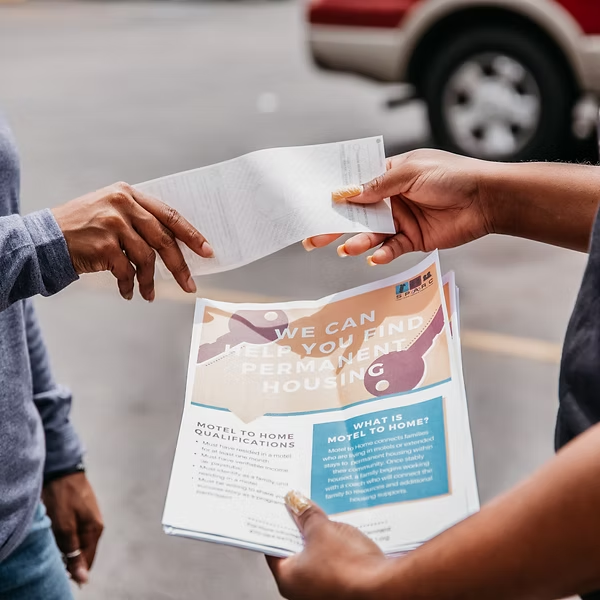
A prominent example is St. Vincent de Paul Georgia’s Motel-to-Home (M2H) program, which was developed in 2019 to assist families to exit motels and access stable rental housing. The M2H program combines financial assistance with individualized support: participants receive one-on-one housing navigation, care coordination, financial coaching, furniture and other wraparound services designed to help families not only secure housing, but maintain long-term stability and independence. M2H includes several partner agencies across Metro Atlanta, brought together by the United Way of Greater Atlanta.
St. Vincent de Paul Georgia’s M2H program data tells a remarkable story. Before entering the program, the average monthly cost for a family living in an extended-stay motel is approximately $2,189. Once housed, that family’s average monthly rent drops to approximately $1,302—a difference of $887 per month. Since the program began in 2019, that savings has translated into approximately $19 million in the family’s own pockets, rather than spent on costly motel rooms. In other words, every dollar invested in the M2H program has helped families unlock significantly greater financial resources each month, while they live in stable, suitable housing.
Just this August, St. Vincent de Paul Georgia (SVDP) served its 1,000th family. These families include 1,662 children who are now living in suitable housing– an incredible milestone.
An investment by the Liz Blake Giving Fund also helped launch SVDP’s savings match and Income Advancement initiatives. These initiatives recognize that housing stability and economic mobility go hand in hand. By helping families build savings and increase their income, the fund helps participants build the financial foundation to remain housed today, and to avoid falling back into the motel trap tomorrow.
SVDP also entered into a partnership with the Wilson Sheehan Lab for Economic Opportunities (LEO) at the University of Notre Dame, a leading research organization focused on applying academic research to evaluate innovative programs that help people move out of poverty. Together, SVDP and LEO researchers will evaluate the M2H program through a randomized controlled trial that uses secondary evidence to quantify the impact of the program as a foundation for families to become more financially secure, healthier and more stable over time.
This research is critical because motel homelessness is largely hidden. While there are no official statistics capturing the full population, estimates suggest as many as 1 million Americans may be living in extended-stay motel rooms. To put this in perspective, the federal point-in-time homelessness count conducted annually by HUD estimates around 745,000 individuals are homeless. Among SVDP’s M2H participants, 97 percent are single heads of household who are women, 95 percent are Black or African American, and on average, families have two children. They are working parents who are paying “rent” in a housing market where the cost of a permanent home is often beyond their reach without targeted intervention.
Helping families escape the motel trap is life-changing. The LEO study provides an opportunity for organizations like SVDP to go one step further: to better understand this hidden form of homelessness, build the evidence needed to scale effective programs and interventions, and attract the philanthropic and public investment necessary to meaningfully reduce homelessness across our country.
The 1,000th family served in SVDP’s M2H program is a milestone to celebrate! It is also an invitation to keep learning, improving and expanding the resources to reduce and ultimately resolve this form of homelessness—and create lasting, intergenerational impact.
For more information about SVDP’s M2H program, please contact Rene Bazel, MBA, MPA, Senior Manager of Institutional Giving, rbazel@svdpgeorgia.org
Brian Goldstone will be the keynote speaker of the Decatur Book Festival on Friday, October 2nd. More information can be found online at: https://www.decaturbookfestival.com/event-details/a-keynote-conversation-with-brian-goldstone
This is sponsored content.


