


Georgia, alongside much of the Southeast, has been experiencing varying levels of intense drought.
The latest from the U.S. Drought Monitor shows 100 percent of Georgia is in drought, with most of Metro Atlanta under extreme drought (D3) or exceptional drought (D4) designations, and smaller swaths of the state falling under D2 (severe drought) or D1 (moderate drought). Statewide, 50.2 percent of the state’s land area is in extreme (D3) drought and an additional 28.5 percent in exceptional (D4) drought, meaning 78.7 percent of Georgia’s land area falls under D3-D4 drought as of the May 19 map.
One month ago, on April 27, 2026, the GA Environmental Protection Division declared a Level 1 Drought Response after meeting with water utilities around the state to discuss water resources.
The declaration means that public water utilities were required to kick off a public information campaign informing their customers about the ongoing drought in at least one form of media, digital or physical. Utilities must also report their monthly water withdrawals on a monthly basis.
Katie Bloomfield, director of external affairs for the GA EPD, said the Level 1 declaration was appropriate given the state of the water resources.
“Drought conditions continue to exist across the state. A Level 1 Drought Response is the appropriate action at this time. EPD will continue to monitor all hydrologic parameters and consider whether other levels of response will be needed,” Bloomfield said.
Georgia has previously experienced droughts of relatively similar magnitude, like in 2016, 2012-2013, 2011, 2007-2008 and 2000, according to Rocky Bilotta, author of the U.S. Drought Monitor. During 2007, an exceptional (D4) drought covered 49.9 percent of the state, making it the largest D4 extent in the state based on the USDM record (since 2000).
Because of all the past droughts, real progress has been made to make the state more prepared and resilient to these kinds of droughts.
“As a result of the previous droughts, the impact of such events, and the responses taken, measures have been put in place as a result,” Bloomfield said, referencing legislation like the 2010 Georgia Water Stewardship Act and regulation like the 391-3-30 Drought Management Rule. “Such measures include state-wide non-drought time watering schedules, plumbing code mandates, water loss audit requirements, and water conservation guidelines,” Bloomfield said, adding that per capita water use has been reduced since then.
“Public water systems serving more than 3,300 people have been participating in the annual water loss audit process. Results of the audits have been incorporated into the permitting process,” Bloomfield added.
However, despite having past droughts to learn from, this drought is still formidable in its own right, according to Bilotta.
“If you look at the weekly Drought Severity and Coverage Index (DSCI) values for Georgia… you can see that the current drought is second only to the drought of 2000 in terms of the total extent of all drought categories,” Bilotta said. He later added, “Georgia is currently experiencing one of its most severe drought events since the U.S. Drought Monitor’s inception in 2000.”

Bilotta said the U.S. Drought Monitor map tries to capture all the dimensions of a drought — a rather tall task, given how drought effects differ from person to person and sector to sector. As such, the U.S. Drought Monitor takes a “convergence of evidence” approach to formulate the map each week.
“Drought is a complex hazard that manifests in different ways. It is often said that drought is defined by those it impacts, meaning it affects different sectors in different ways,” Bilotta said. “In response to these differences, drought is categorized based on its specific impacts (such as meteorological, hydrological, agricultural, ecological, and socioeconomic). For instance, a farmer’s experience of drought will look very different from that of a municipal water supply manager.”
In the past week, parts of metro Atlanta received some drought respite in the form of heavy rainfall — in some parts, even flooding. One image went viral showing a Waymo, an autonomous self-driving car, plowing through a flooded street.
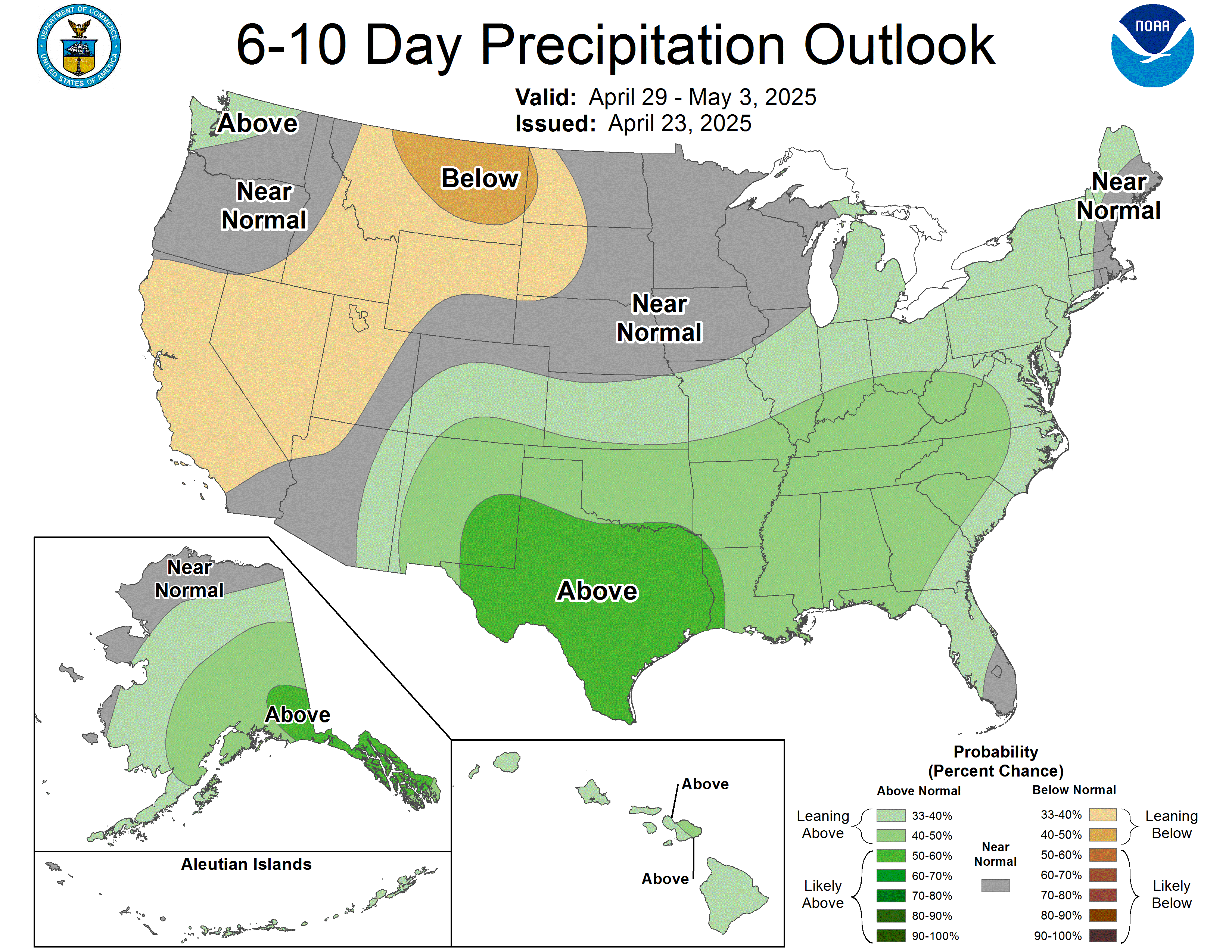
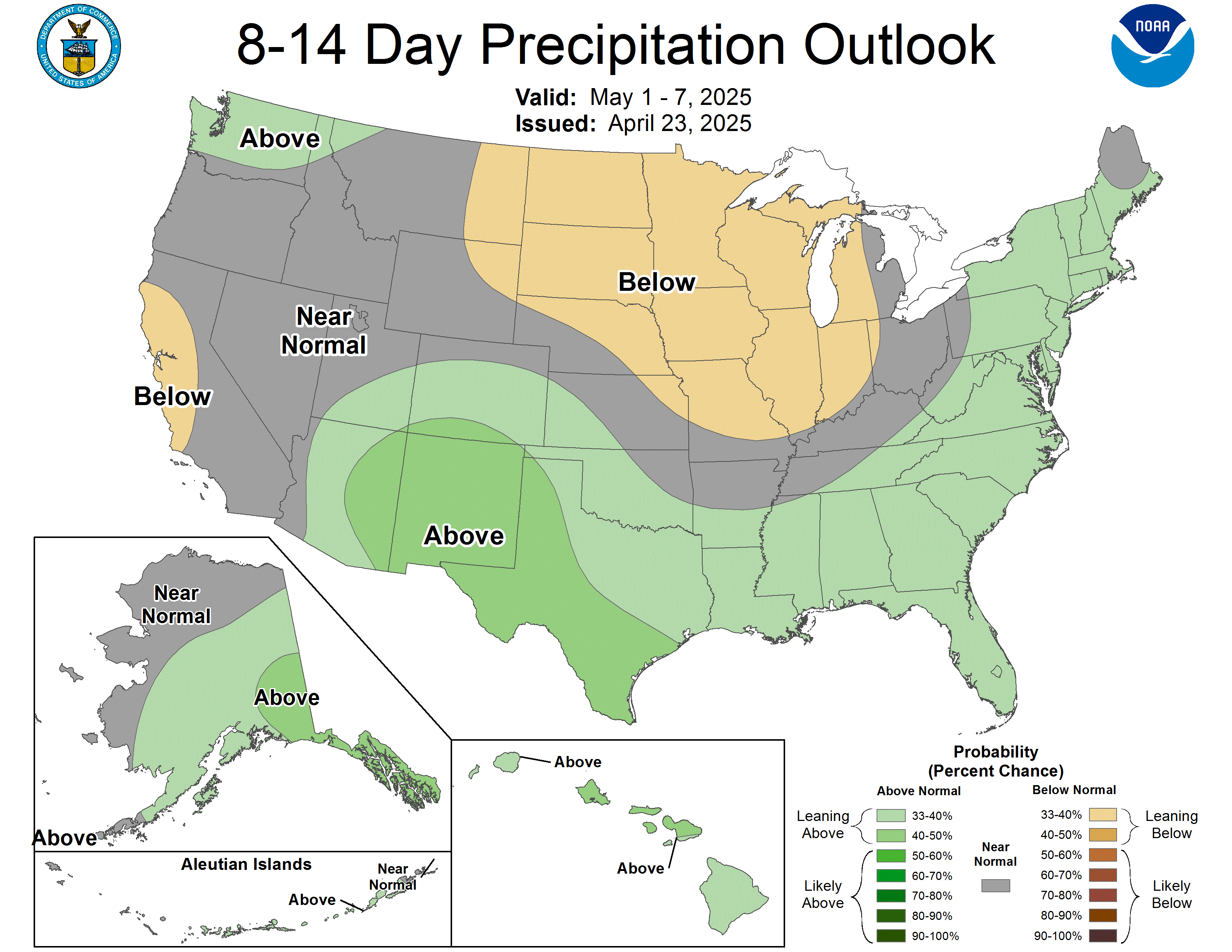
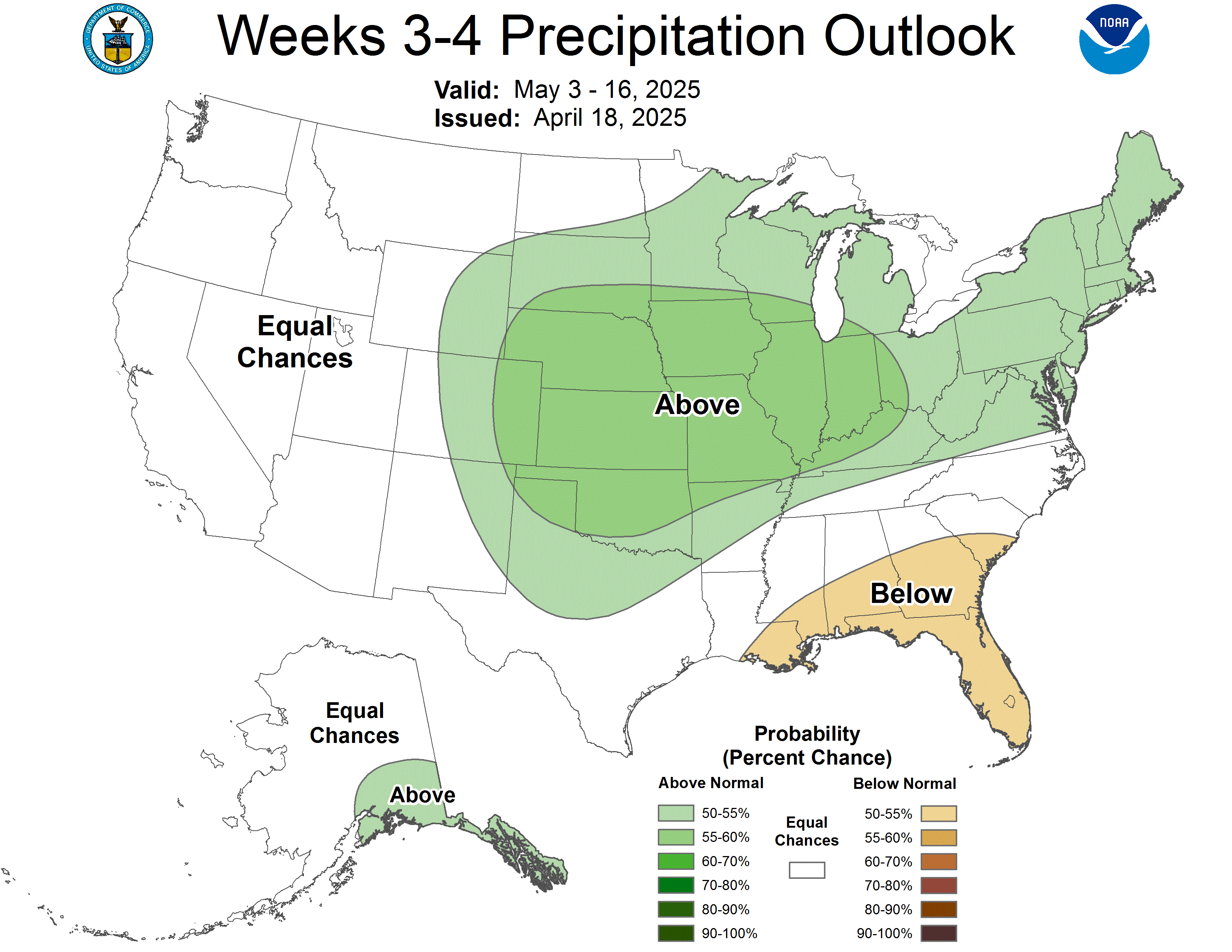
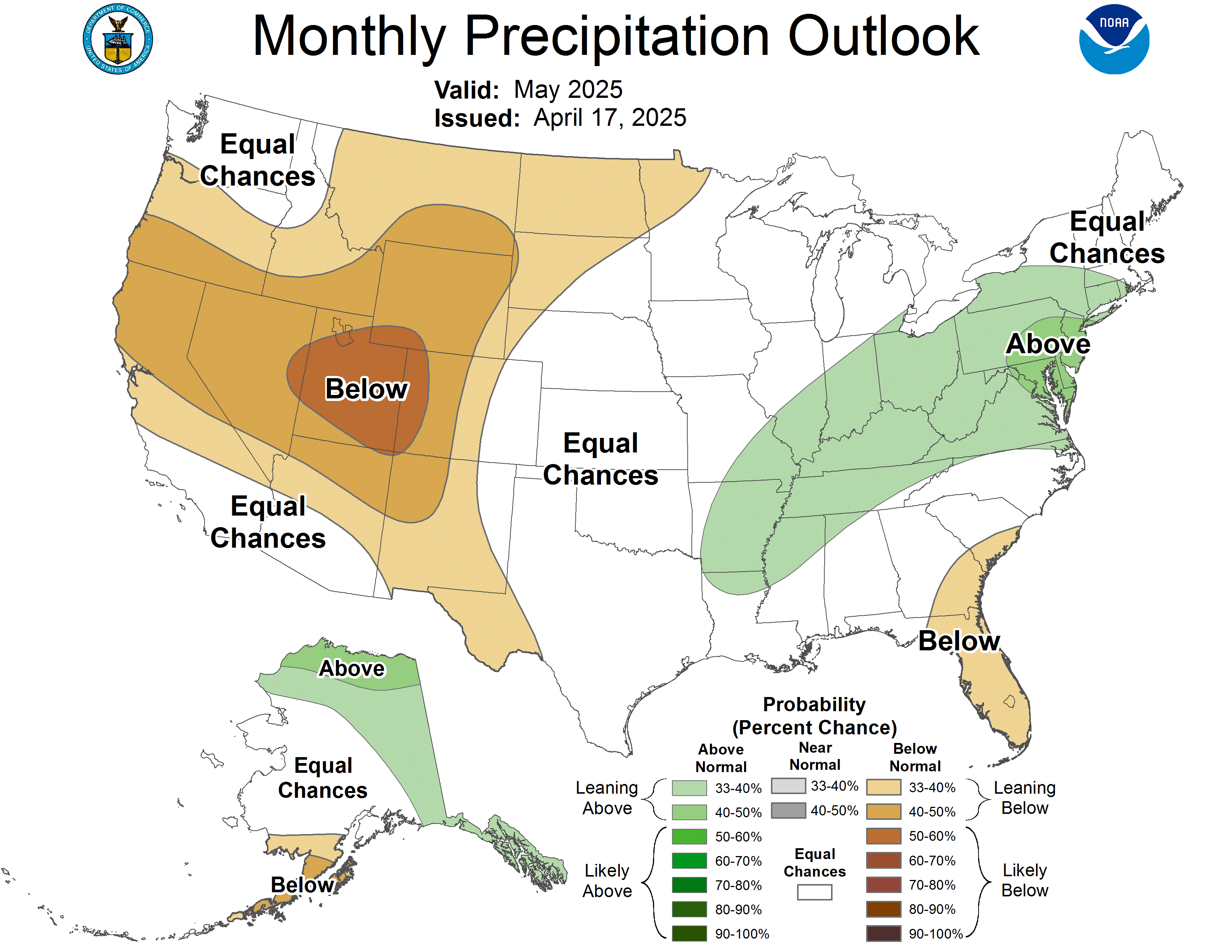
Moreover, the National Weather Service’s Climate Prediction Center’s 6-10 day, 8-14 day, 3-4 week, and monthly outlooks all indicate that most of Georgia has varying chances of above-normal precipitation.
This shouldn’t be mistaken as an end to the drought, however. The National Weather Service’s Climate Prediction Center’s Monthly Drought Outlook valid for May 2026, released on April 30, predicted that the drought will persist; the next monthly drought outlook won’t be released until May 31.

“It is easy to assume that a heavy rainstorm will alleviate drought conditions — and it very well could in some cases — but for a hydrological drought, replenishing streamflow, reservoir, and groundwater levels will likely require sustained, long-term rainfall, not just a single heavy thunderstorm,” said Bilotta. “That said, precipitation plays a major role in creating the map. While all droughts originate from a rainfall deficiency, precipitation is just one input the authors consider. Because of this hazard’s complex nature, no single indicator tells the full story.”
Looking ahead with El Niño on the horizon
The National Weather Service (NWS) gives an 82 percent chance that El Niño will form sometime between May and July 2026.
El Niño is a naturally occurring phenomenon that sees warming ocean temperatures in parts of the Pacific Ocean, along with weaker east-west trade winds along the equator. Its effects, which strongly influence weather patterns across the U.S., could bode well for a Southeast that is desperately dry.
“Atmospheric teleconnections, such as El Niño and La Niña events, strongly influence weather patterns over Georgia and the rest of the United States,” Bilotta said. “During the cool months of an El Niño, a strengthened subtropical jet stream directs moisture from the Gulf across the southern U.S. For Georgia, that typically means a cooler and wetter winter.”
While the timing of its formation is likely, the NWS says predicting its peak strength comes with much less certainty.
“It’s difficult to gauge the strength of this El Niño since we are just now slowly transitioning from ENSO Neutral to El Niño over the next month or two; it could be a moderate to strong event but we will have to see,” Bloomfield said.
The National Oceanic and Atmospheric Administration (NOAA) recently predicted a below-normal Atlantic hurricane season, due in part to El Niño, though this does not necessarily mean the phenomenon itself will be weak.
“[It’s] still possible to get strong tropical cyclones during El Niño events (Michael, Idalia), because of all the other factors at play — very warm sea surface temps in the Atlantic and Caribbean Sea, Saharan dust, etc.,” Bloomfield said.
What the effects of this likely incoming El Niño will have on Georgia’s drought struggles remain to be seen.
What is certain, however, is that regardless of the climate phenomenon, Georgia will need more rainy days ahead to return to normal levels.
“On the surface, it’s easy to see a lawn green up after a summer thunderstorm and think things are fine. But beneath the surface, the state is locked in a deep hydrologic deficit,” Bilotta said. “This crisis didn’t occur overnight — it is the result of months of record-breaking dryness — and it will take a sustained period of widespread rain to return to normal.”


Leave a comment