


By Eleanor Ringel Cater
“Ma Rainey’s Black Bottom” was the first August Wilson play I ever saw. And I saw it under ideal conditions, in the early ‘80s, in previews, before it made its official Broadway debut. The buzz was considerable, and I was ready to be swept off my feet.
Only, I wasn’t. I didn’t connect with Wilson’s genius until I saw several of his plays staged by Kenny Leone at the Alliance. Theatre.
That didn’t mean I wasn’t eager to see the new Netflix presentation of “Ma Rainey.” Especially since it starred Viola Davis, who’d just won an Oscar for her work in another Wilson piece, “Fences.” More importantly, it would be my last chance to see Chadwick Boseman who died tragically young of pancreatic cancer last summer.

The set-up is pretty simple. In the 1920s, Ma Rainey (Davis), known as the Mother of the Blues, is in Chicago with her band to make a new record. As usual, Ma is late, leaving her band – newcomer Levee (Boseman) on trumpet, pianist Toledo (Glynn Turman), bandleader Cutler (Coleman Domingo) and Slow Drag (Michael Potts) on bass – to hang out and wait in the stifling basement recording room.
The veterans just want to get done and get out, but the ambitious Levee has a couple of things on his mind: his slick new yellow shoes and, more importantly, his slick new arrangement of one of Ma’s songs.
When Ma finally does arrive, the obsequious white guys who run the studio try desperately to do her bidding, be it fetch her a Coke RIGHT NOW or let her nephew introduce her song, despite his pronounced stutter.
The song does get done, but not without tension and, ultimately, tragedy. On stage, the last-act stunner didn’t quite work, and, for whatever reason, it doesn’t here, either. It seems less the fault of either production than the play itself. Remember, “Ma Rainey” was one of Wilson’s earliest works and it could’ve probably used one last polish.
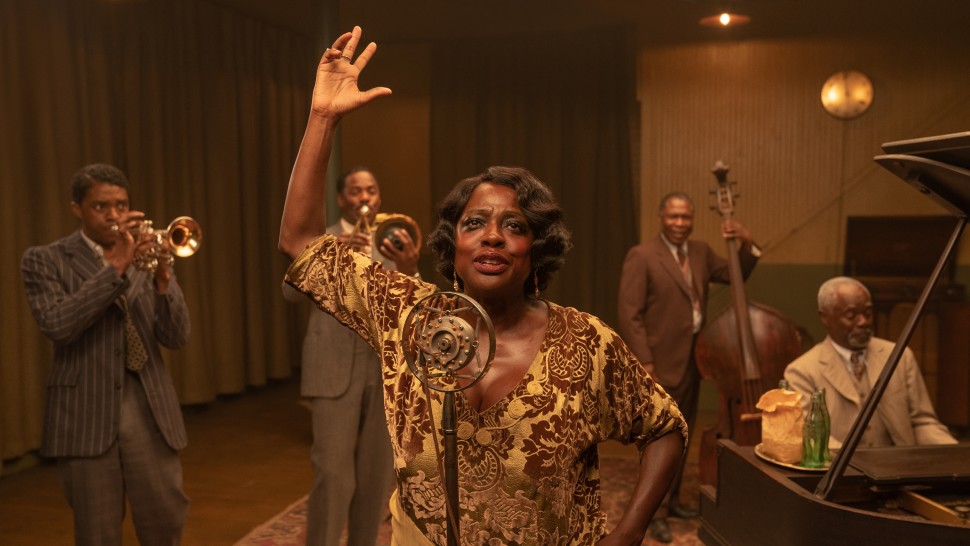
But director George C. Wolfe, himself a major Black playwright and director, seems at sea, as if he instinctively knew where the weaknesses were but wasn’t sure what to do about them. Davis, for all her effort, is problematic, too. Her Ma is a kind of diva’s diva, with her heaving breasts, runny eye make-up and don’t-mess-with-me attitude. But at the core of her performance is a slight back-up, a slight sense of, well, you should like me anyway. And you can see her point; consider what Ma has had to endure as a Black person and a woman. Still, there’s a deep-down poison that’s missing, a hard-as-nails ego with no room for compassion or even flexibility.
That leaves us with Boseman, the real, perhaps the only reason to see “Ma Rainey’s.” He’s magnificent here, totally different than we’ve ever seen him – fluid and a bit of a rascal. Cynical, too. And arrogant. He put me in mind of the young Richard Pryor, especially when he was being cast as a kind of trickster figure in films where things didn’t always turn out well for his character (remember Piano Man in “Lady Sings the Blues”).
Boseman is mesmerizing and posthumous awards, from Oscars to critic groups, seem assured. And I’d trade all the honors for the chance to see him act one more time.


